

Hi there,
Embedded analytics is moving past the dashboard era.
For SaaS companies, the bigger question is no longer whether analytics can be added to the product. It is whether analytics can help customers get better answers, take action faster, and stay engaged long enough to make the product harder to replace.
That shift changes what teams need to care about. AI features introduce token costs. Embedded analytics requires real architecture. Data transformation becomes part of the product foundation. And differentiation only matters if buyers can actually see it during the sales process.
In this edition, we look at the economics, infrastructure, and product strategy behind embedded analytics that does more than report on the business.
It becomes the foundation your customers rely on to understand, decide, and act.

📰 Upcoming in this issue
Token Economics
Data Transformation: The Backbone of Scalable Embedded Analytics
Can your analytics help you win new business? Sure, under three conditions.
📈 Trending news
Why SaaS Companies Need AI Engineering Guardrails
The Token Economy Is Changing SaaS Finance
How Tool Calling Is Rewriting SaaS Workflows
Token Economics
The cost of infrastructure for traditional software is billed by processing power, memory, and storage. AI systems are often billed by “tokens processed”. The AI industry defines a token as a "unit of work”. As a simple rule of thumb, in the context of an English conversation, you can count every 4 characters, or .75 of a word, as a token.
Not perfect, but good enough to correlate with the computational effort required to run a large language model (LLM). It's neither completely arbitrary nor a fundamental scientific constant—it's an engineering construct that is precisely defined for a given model. While tokenization for a specific model is exact and deterministic, there is no universal token standard.
If you're building AI-enabled SaaS products, token economics matter.
Suppose an AI interaction contains a user request (500 tokens), retrieved context (10,000 tokens), system prompt (2,000 tokens), and AI response (1,500 tokens). In total, such a process will use 14,000 tokens. Doing 1 million such interactions per month will consume 14 billion tokens monthly.
The difference between an 8,000-token and a 14,000-token workflow can be the difference between a profitable AI feature and one that is too expensive to be used.
This is the main reason why companies spend so much effort on:
RAG optimization
Context compression
Prompt engineering
Caching
Smaller specialized models
Over time, as AI usage increases (and so do costs), these optimizations will become increasingly important and one of the most valuable aspects of an embedded AI platform.
I see this as an opportunity for embedded AI to excel in optimizing the cost of leveraging AI to help analytics, so SaaS companies can take advantage of an embedded model not only to add functionalities but also to do it cost-effectively.
SaaS companies that want to build/integrate AI into their analytics on their own should allocate a fair share of their resources to optimize the cost and over time maintain it as well.
Working with a cost-effective model opens the door for SaaS products to have a profitable monetization of AI.
Key Takeaways:
AI costs scale by usage: More tokens mean higher costs.
Workflow size matters: Small token differences become expensive at scale.
Token efficiency affects margins: Prompts, context, caching, and model choice all matter.
Embedded AI must control cost: Useful AI also has to be scalable and affordable.
Monetization needs discipline: Profitable AI features require careful cost management.
Data Transformation: The Backbone of Scalable Embedded Analytics
In embedded analytics, what happens before the dashboard loads is just as important as what users see on screen. For SaaS companies managing multi-tenant environments, data transformation isn’t just a backend task—it’s a strategic capability that determines whether your analytics platform can scale, perform, and empower users.
Data transformation is more than just a processing step
Data transformation refers to the process of reshaping raw, often messy, source data into a format that’s optimized for analysis. This includes cleaning inconsistencies, joining disparate datasets, creating calculated fields, and applying tenant-specific filters.
In a multi-tenant SaaS context, these transformations must happen dynamically, securely, and often in real time. Without this capability, analytics becomes rigid and fragile—dependent on external ETL pipelines, manual workarounds, and constant engineering support.
Multi-tenant SaaS demands built-in data transformation
Many embedded analytics platforms treat transformation as someone else’s problem. They assume your data is already clean, modeled, and ready to query. But in reality, SaaS companies deal with fragmented schemas, evolving data models, and tenant-specific logic that can’t be hardcoded.
Without native transformation capabilities, teams are forced to preprocess data outside the analytics layer, manage tenant-level logic manually, and maintain brittle infrastructure that doesn’t scale. This slows down iteration, increases engineering overhead, and limits your ability to deliver differentiated experiences to your customers.
Platforms with built-in transformation capabilities change that. They allow you to apply business logic directly within the analytics layer, dynamically segment data by tenant, and support both co-mingled and isolated data models.
The unmatched advantage: built-in data transformation and analytics database
Data transformation is powerful on its own—but when paired with a built-in analytics database, it becomes a force multiplier.
When the transformation engine runs close to the data, latency drops, complexity disappears, and performance improves. You’re no longer pushing compute to an external warehouse or relying on your production database to serve analytical queries. Instead, you gain full control over how data is shaped, stored, and served—per tenant, per use case, and per product experience.
This combination—native transformation plus a built-in data engine—is what unlocks real-time, governed, and cost-efficient analytics at scale.
When evaluating embedded analytics platforms, ask whether the platform:
Supports native data transformation
Can apply logic per tenant, securely and at scale
Pairs transformation capability with a built-in analytics database
This Evaluation Guide from Qrvey can help you assess the things that matter most for the SaaS embedded use case. Key features like self-service experience, data management, deployment, and embedding capabilities are explored in depth and come with key questions to ask vendors.
Read the evaluation guide here.
Can your analytics help you win new business? Sure, under three conditions.
Embedded analytics does not win deals just because it exists.
Most SaaS buyers have already seen dashboards, reports, and charts. Those are useful, but they rarely make a product feel meaningfully different on their own.
For analytics to actually help a SaaS company win more deals, three things need to happen.
First, the platform has to support real differentiation. If the analytics only gives users standard dashboards and fixed reports, buyers will treat it like a basic feature. The real edge comes when analytics helps users spot changes, understand what those changes mean, and connect insight directly to action.
Second, the capability has to be built into the product experience. Analytics should not feel like a separate reporting tab. It should change how the product works, how users make decisions, and how quickly they can act.
Third, the difference has to be obvious during the buying process. If buyers only see analytics late in the demo, it feels like an add-on. If they see it from the first conversation through the final comparison, it becomes part of the reason they choose one product over another.
That is where the five-step framework comes in.
The three conditions explain what must be true. The five steps below explain how SaaS companies can make those conditions show up in the product, the demo, the sales process, and the buyer’s final decision.
The Five Steps to Winning with Embedded Analytics
Step 1 — Ensure the product actually differentiates
The analytics capability must go beyond dashboards and reporting and support meaningful differentiation.
Step 2 — Expose differentiated analytics capabilities in the product
The most powerful capabilities of the analytics platform must be surfaced in ways customers can actually use.
Step 3 — Introduce analytics early in the buying process
Analytics must appear in the website, positioning, and early conversations so it shapes how buyers understand the product from the start.
Step 4 — Demonstrate differentiated analytics clearly in the demo
The demo must show advanced analytics capabilities in the context of real product workflows, not as separate reports or isolated features.
Step 5 — Reinforce analytics differentiation until it becomes a reason to choose
The same ideas must be repeated across marketing, sales, follow-up interactions, and internal discussions until buyers use them to explain the decision.
When these steps are followed, embedded analytics moves from being something that is included in the evaluation to something that helps determine its outcome.
Why It Matters
Embedded analytics must now be core to your product experience.
For SaaS teams, that means the hard questions are no longer just about dashboards. They are about cost, architecture, governance, data transformation, and whether analytics helps customers act faster.
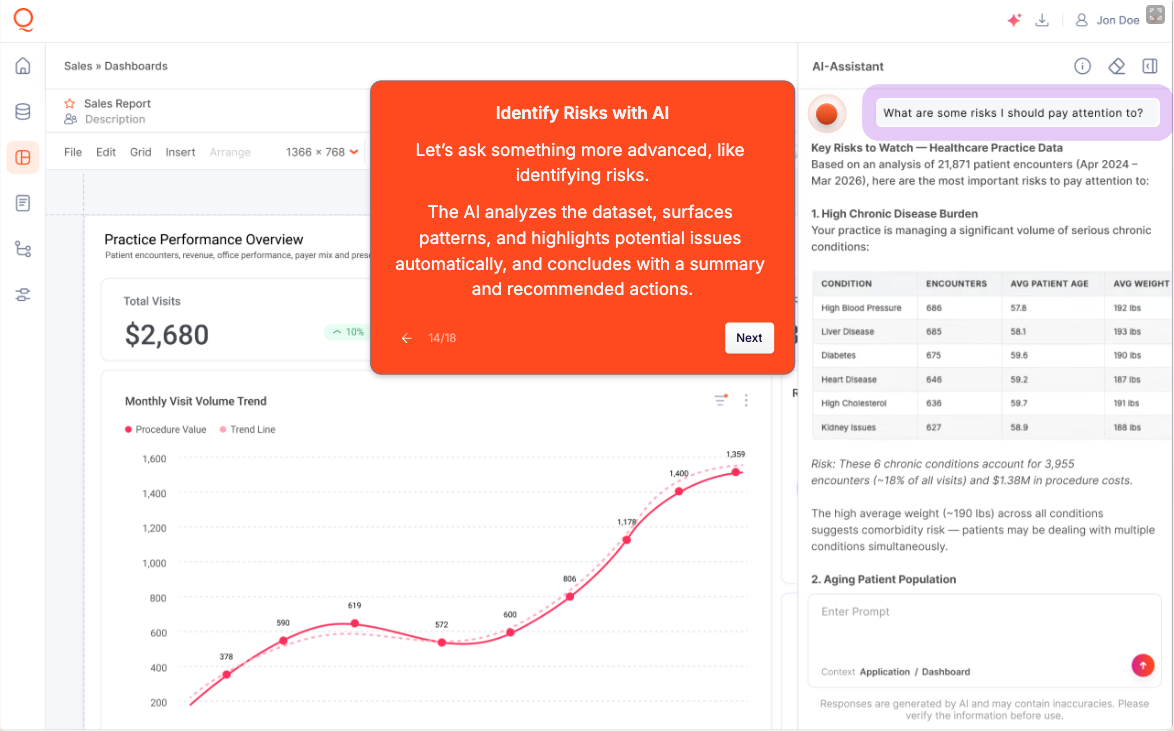
The winners will not add the most AI. They will make AI and analytics feel useful, controlled, and native to the way customers already work.
See you in the next edition,
Arman Eshraghi
The Embedded Intelligence Brief
Connect on LinkedIn